
Keeping customers safe: A reminder on carbon monoxide alarms
With Carbon Monoxide Awareness Week approaching, OFTEC is reminding technicians of the importance of checking that suitable carbon monoxide (CO) alarms are installed and correctly positioned whenever they work on heating appliances. Correct alarm provision is a vital safety measure and applies to both new and existing installations.
Carbon monoxide detectors should be installed in the same location as any fixed combustion appliance installed internally or within a restricted external area. This applies regardless of whether the appliance is room-sealed or open-flued.
Detectors should comply with BS EN 50291 and be either:
Powered by a battery designed to operate for the working life of the alarm, incorporating a warning device to alert users when the alarm is approaching the end of its working life; or
Powered by mains electricity with fixed wiring (not plug-in types) and incorporating a sensor-failure warning device.
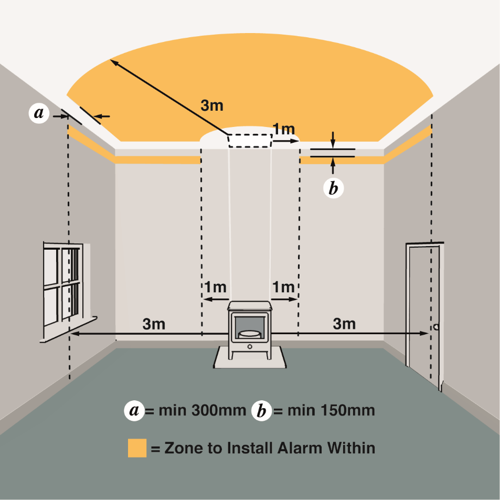
CO detectors must be securely and permanently installed in one of the following locations (or as otherwise specified by the manufacturer):
Between 1m and 3m horizontally from the appliance; and either
On the ceiling, at least 300mm from any wall; or
On a wall, above any doors and windows, as high as possible but not within 150mm of the ceiling.
Regional requirements
Technicians should also be aware that additional CO alarm requirements apply across different regions:
England and Wales: CO detectors must be fitted in any room used as living accommodation in rented properties containing an appliance.
Northern Ireland: If the appliance is installed in a room or space not normally occupied (for example, a boiler room or cupboard), the detector should be located just outside the room or space so the alarm can be heard more easily. In rented accommodation, a detector must be installed in any room or circulation space (hall, stairs, landing or corridor) that contains an appliance or through which a flue passes.
Scotland: Additional CO detector(s) are required in high-risk accommodation, such as bedrooms or principal habitable rooms, where a flue passes through the room. A carbon monoxide detector should not be sited in an enclosed space (for example, a cupboard or behind a curtain), where it may be obstructed by furniture, directly above a sink, next to a door or window, next to an extract fan, next to an air vent or similar ventilation opening, in an area where temperatures may fall below -10°C or exceed 40°C (unless designed to do so), where dirt or dust may block the sensor, in a damp or humid location, or in the immediate vicinity of a cooking appliance.
Wales: Additional CO detector(s) are required in high-risk accommodation, such as bedrooms or principal habitable rooms, where a flue passes through the room. A carbon monoxide detector should not be sited in an enclosed space (for example, a cupboard or behind a curtain), where it may be obstructed by furniture, directly above a sink, next to a door or window, next to an extract fan, next to an air vent or similar ventilation opening, in an area where temperatures may fall below -10°C or exceed 40°C (unless designed to do so), where dirt or dust may block the sensor, in a damp or humid location (unless designed to do so), or in the immediate vicinity of a cooking appliance.
Jersey: In rented dwellings, a CO detector must be fitted in any room containing an appliance.
Republic of Ireland: An additional CO detector is required either inside each bedroom or within 5m of the bedroom door, measured along the corridor route. Where a system chimney passes within or over a habitable room, whether encased or not, a CO detector should also be fitted in that room. Alarms located in bedrooms should be positioned close to the occupants' breathing zone. Where a single room serves as living accommodation, the alarm should be located as far as possible from cooking appliances while remaining close to the sleeping area.